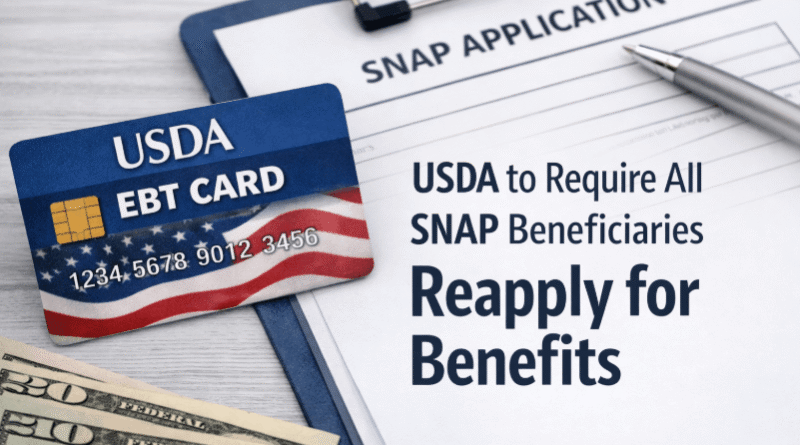
USDA to Require All SNAP Beneficiaries Reapply for Benefits in 2026
The USDA to require all SNAP beneficiaries reapply for benefits is a 2026 federal mandate established by the One Big Beautiful Bill Act (OBBBA). This directive necessitates that all 42 million current SNAP recipients undergo full recertification to verify identity, income, and residency.
To prevent benefit termination, households must submit a new application and complete a mandatory interview during their state-assigned 2026 window.
Critical Policy Changes for 2026 SNAP Recipients
- Mandatory Re-Enrollment: Previous simplified reporting extensions are abolished; a fresh FNS-recertification form is required for all active cases.
- Expanded Work Mandates: The Able-Bodied Adults Without Dependents (ABAWD) age limit has increased to 64. Non-exempt adults must document 80 hours of work or training monthly.
- Income Verification: USDA now utilizes real-time IRS 1099-K and Social Security data to cross-reference reported income against 2026 federal thresholds.
- State Penalties: The OBBBA imposes fiscal penalties on states with payment error rates above 6%, driving aggressive manual audits and re-verifications.
USDA to Require All SNAP Beneficiaries Reapply for Benefits
Under the One Big Beautiful Bill Act (OBBBA) of 2025, the USDA now requires all 42 million SNAP beneficiaries to reapply for benefits during the 2026 calendar year. This federal mandate shifts the program to a zero-trust model to address national payment errors and verify participant eligibility.
Key Requirements for Beneficiaries
- Action Required: You must submit a new application and complete a mandatory interview during your state-assigned 2026 window.
- Verification: Households must provide updated proof of identity, income, and residency.
- The Deadline: Look for a Notice of Expiration in the mail. Missing your specific state window will result in the immediate deactivation of your EBT card.
- The Goal: Section 10105 of the OBBBA authorizes state agencies to “purge” inactive or “zombie” accounts to ensure fiscal accuracy.
NOTE: This is a one-time mandatory re-certification. Continuous eligibility is no longer automatic under the new federal guidelines.

The 2026 SNAP Re-Enrollment Mandate
The USDA to require all SNAP beneficiaries reapply for benefits is a direct response to Section 10105 of the OBBBA, which targets Program Integrity.
Under the leadership of Secretary Brooke Rollins, the USDA has moved from a continuous eligibility model to a zero-trust framework. This means that every Electronic Benefit Transfer (EBT) cardholder in the nation is subject to a manual review.
If a beneficiary fails to re-enrol within their state’s specified timeframe, often triggered by a Notice of Expiration sent via mail, their benefits will be deactivated on the first day of the following month.
What Does the One Big Beautiful Bill Act (OBBBA) Say About Food Stamps?
The One Big Beautiful Bill Act, signed in July 2025, fundamentally restructured the financial and administrative burden of food assistance.
Critically, it shifted the administrative cost share from a 50/50 federal-state split to a 75/25 split in favor of the federal government, but with a major catch: states must now pay a portion of the actual benefit costs if their payment error rate (fraud or administrative mistakes) exceeds 6%.
This legislative change has forced states to be far more rigorous. The USDA identified over 500,000 zombie accounts, including benefits issued to deceased individuals or multi-state registrants, in late 2025.
Consequently, the 2026 reapplication process requires exhaustive documentation, including SNAP benefits immigration status guidance for non-citizens and residency proof for all household members.

New SNAP Work Requirements for Ages 18–64
The OBBBA expanded the definition of work-capable adults. Previously, many work rules softened or ended at age 54. In 2026, the ABAWD age ceiling is 64.
- The 80-Hour Requirement: Unless exempt, adults aged 18–64 must work, volunteer, or participate in a job training program for at least 20 hours per week (80 hours per month).
- Narrowed Exemptions: The exemption for parents has been tightened. While previously, children under age 6 were granted a waiver, many states now require parents of children aged 14 and older to meet work mandates.
- Three-Month Limit: Failure to meet these requirements restricts a recipient to only three months of SNAP benefits in a three-year period.
How to Reapply for Food Stamps in 2026: A Step-by-Step Guide
To navigate the USDA SNAP reapply mandate, participants must follow a specific regulatory sequence:
- Acknowledge the Notice: States must send a written notice 45 to 60 days before your certification period ends.
- Submit the Application: Use your state’s official portal. Paper applications are still accepted but are subject to longer processing delays.
- Provide Real-Time Verification: Submit pay stubs for the most recent 30-day period. Note that households calculating If I make $1,800 a month can I get Food Stamps, be aware that this amount may exceed the 130% Federal Poverty Level (FPL) for a single-person household in 2026.
- Complete the Interview: This is a non-negotiable federal requirement. The interview may be conducted via telephone or in person at a county social services office.

SNAP Reapplication Facts and Federal Regulatory Position
| Myth | Reality |
| Reapplication is optional for long-term users. | All recipients must reapply to maintain eligibility under OBBBA. |
| You can skip the interview if income hasn’t changed. | The mandatory interview is a 2026 federal requirement for all. |
| Work requirements end at age 55. | The OBBBA extended ABAWD work rules to age 64. |
| Immigration status does not need re-verification. | All non-citizen statuses must be re-verified against the new 2026 rules. |
| EBT cards remain active during processing. | Benefits will stop if the reapplication is not approved by the deadline. |
Will Your EBT Benefits Be Delayed During Reapplication?
Administrative processing bottlenecks are expected. According to FNS (Food and Nutrition Service) guidelines, states have 30 days to process a standard application. However, because 2026 involves a total rebuild of the system, many states are experiencing backlogs.
To avoid a gap in food assistance, submit your reapplication at least 15 days before your current certification expires.
If your application is delayed due to an Agency Error, you are entitled to retroactive benefits. If it is delayed due to your failure to provide documents, including documentation regarding assets or transfers, mirroring the scrutiny found in the 7 year look-back period for Medicaid to ensure complete compliance.
New 2026 SNAP Income Limits and Monthly Allotments
| Household Size | Gross Monthly Income (130% FPL) | Max Monthly Allotment |
| 1 | $1,632 | $291 |
| 2 | $2,215 | $535 |
| 3 | $2,798 | $766 |
| 4 | $3,380 | $973 |
How the USDA Fraud Purge Eliminates Zombie Accounts
According to USDA Secretary Brooke Rollins, the 2026 reapplication is a reset intended to save taxpayers approximately $15 billion annually.
The USDA has deployed a new National Accuracy Clearinghouse (NAC) to catch cross-border fraud where individuals claim benefits in two different states simultaneously.
By mandating a fresh application for all 42 million participants, the federal government aims to verify that every dollar is going to a vulnerable citizen who literally cannot survive without it.
Conclusion
The 2026 SNAP landscape is defined by a shift toward maximum administrative rigor. This initiative is not a routine check-in; it represents a fundamental re-verification of the national database to align with the OBBBA’s strict fiscal standards.
Success for recipients depends on proactive compliance with state deadlines and the expanded work mandates for those under 65.
USDA to require all SNAP beneficiaries reapply for benefits means a mandatory total re-verification of eligibility for every household in 2026.
FAQ
Are all SNAP recipients required to reapply?
Yes. The OBBBA mandate effectively ends simplified reporting for 2026. Every household, regardless of history or stability, must submit a new application to verify they meet the tightened eligibility and work standards.
Can I stay on SNAP benefits forever?
No. For most able-bodied adults without dependents, benefits are limited to three months every three years unless the 80-hour monthly work or training requirement is consistently met.
What foods are now banned under the OBBBA 2026 rules?
The OBBBA did not pass a universal junk food ban, but it granted states more power to limit luxury or non-nutritious items. For example, Texas and Florida have implemented pilot programs restricting the purchase of sweetened sodas and high-sugar snacks.
Is it true that I cannot buy soda with EBT in 2026?
No. There is no nationwide federal ban on soda as of April 2026. However, check your specific state’s 2026 Ineligible Items list, as several states have received waivers to implement local restrictions on sugary beverages.
Will my Social Security COLA affect my SNAP reapplication?
Yes. Because SNAP eligibility is calculated based on gross income, a cost-of-living adjustment (COLA) to your Social Security or SSI payment can push your household income over the limit, potentially reducing your monthly SNAP allotment.
Can I refuse the mandatory interview and keep my benefits?
No. The interview is a technical requirement for verification. Failure to participate in the scheduled interview (via phone or in-person) will result in an automatic denial of your reapplication for Failure to Cooperate.
What happens if I miss my recertification deadline?
If you miss the deadline, your case is closed immediately. You will have to file a completely new application rather than a simple recertification, which may result in a 30-day waiting period without benefits.
Do work requirements apply if I am already working 20 hours?
If you are already working 20 hours or more per week (80 hours per month) and can prove it with pay stubs, you satisfy the work requirement. However, you still must complete the reapplication process and the interview to keep your benefits active.