SNAP Benefits Immigration Status Guidance 2026: Get Eligible
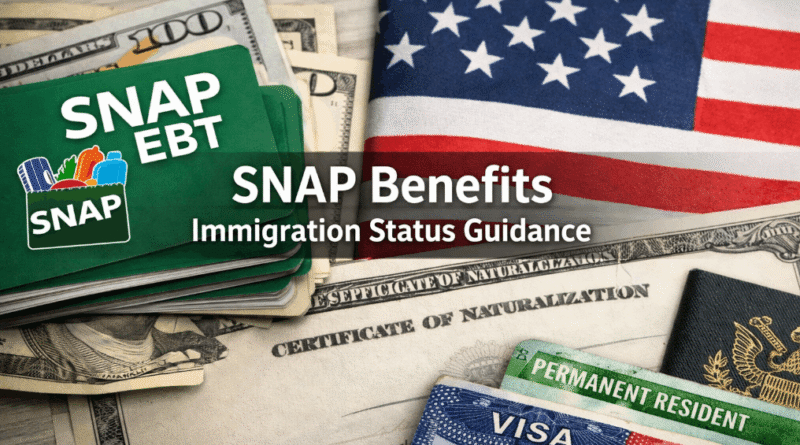
SNAP benefits immigration status guidance is the regulatory framework used to determine food assistance eligibility for non-citizens.
As of April 2026, federal law restricts SNAP primarily to Lawful Permanent Residents (LPRs), Cuban/Haitian entrants, and COFA migrants.
Most other categories, including newly admitted refugees and asylees, must now adjust their status to LPR before they can qualify for benefits.
Key Takeaways for 2026
- The 5-Year Mandate: Most Lawful Permanent Residents (Green Card holders) must wait five years before qualifying, though minors and the disabled are exempt.
- Refugee Status Shift: Under the OBBB Act, Refugee or Asylee status alone no longer triggers immediate SNAP eligibility; adjustment to LPR status is now a prerequisite.
- Public Charge Neutrality: USCIS 2026 standards confirm that legitimate SNAP use by eligible individuals (or for their children) does not categorize a person as a Public Charge.
- Privacy for Non-Applicants: Parents applying solely for their U.S. citizen children are not required to disclose their own immigration status or provide a Social Security Number.
2026 SNAP Eligibility Formula
To qualify for assistance under the OBBB Act 2025, a household must satisfy this three-part technical equation:
Eligible = [Qualified Immigration Status] + [5 Years LPR Residency] + [Gross Income < 130% FPL]*
*Note: The 5-year wait is waived for minors, the disabled, and specific military categories.
What is Meant by SNAP Benefits Immigration Status Guidance?
In the regulatory landscape of the USDA Food and Nutrition Service (FNS), immigration status guidance refers to the protocols state agencies use to verify an applicant’s Qualified Alien standing.
This process is governed by Section 402 of the Personal Responsibility and Work Opportunity Reconciliation Act (PRWORA), as amended by the One Big Beautiful Bill Act of 2025.
The guidance dictates how the SAVE (Systematic Alien Verification for Entitlements) system, managed by USCIS, is used to cross-reference Department of Homeland Security (DHS) records.
For the reader, this guidance is the roadmap that determines if their specific visa or residency code permits entry into the federal safety net.
Why People Search for SNAP Benefits Immigration Status Guidance
The search volume for this topic in 2026 is driven by two distinct factors: Policy Volatility and Legal Anxiety.
- Policy Volatility: The April 2026 Redetermination Wave has seen thousands of households lose benefits because their prior status (such as Humanitarian Parole) was eliminated from the eligible list by Section 10108.
- Legal Anxiety (The Chilling Effect): Families often fear that applying for food assistance will jeopardize their Good Moral Character assessment during naturalization or trigger a Public Charge inadmissibility during a green card interview.
This guidance serves as a technical buffer, providing the specific legislative citations, like 7 CFR 273.4, that protect eligible immigrants from administrative overreach.
Who Operates the SNAP Benefits Immigration Process?
The SNAP immigration process is a tripartite operation involving federal oversight and state-level execution:
- USDA (Food and Nutrition Service): The primary regulatory body. It sets the national eligibility criteria and issues the FNS 227 policy manuals that states must follow.
- State HHS/DHS Agencies: These are the frontline offices. They conduct interviews and collect physical documentation (I-551, I-94).
- USCIS (DHS): Operates the SAVE database. When a caseworker enters an Alien Registration Number, USCIS provides the real-time status code that confirms eligibility.
- SSA (Social Security Administration): Vital for LPRs attempting to bypass the 5-year wait. The SSA verifies if the applicant has 40 qualifying quarters of work history.
Eligibility for SNAP Benefits Immigration
Under the 2026 Regulatory Reset, non-citizens must fall into one of three primary silos to participate in the FNS program:
- Lawful Permanent Residents (LPRs): Subject to a five-year waiting period (with exceptions).
- Cuban and Haitian Entrants: Eligible immediately upon entry.
- COFA Migrants: Citizens of the Federated States of Micronesia, Marshall Islands, and Palau are eligible immediately.

SNAP Immigration Eligibility Facts vs Misconceptions
| Myth | Reality |
| All legal immigrants can get SNAP. | Only Qualified categories under Section 10108 are eligible. |
| Using SNAP will lead to ICE enforcement. | SNAP data is protected; applying for others does not trigger enforcement. |
| Refugees get SNAP immediately. | 2026 rules require refugees to adjust to LPR status first. |
| You need an SSN to apply for your kids. | Non-applicant parents can opt out of providing an SSN for themselves. |
New Federal Requirements for Refugee and Asylee SNAP Access
A significant Blind Spot in current online literature is the 2026 shift regarding humanitarian statuses. Historically, being a Refugee was a permanent ticket to SNAP eligibility. As of February 1, 2026, this has changed.
Under the new Section 10108 Framework, a refugee must now adjust status to LPR. Once they become an LPR, the five-year waiting period is waived, provided they were previously a refugee.
This subtle technicality means that a refugee who has not yet applied for their green card may find their SNAP benefits terminated during their 2026 recertification.
Sponsor Deeming and the 130% Indigent Exemption
If you were sponsored for your green card via Form I-864, the state will deem your sponsor’s income as yours. This often disqualifies applicants. However, the Indigent Exemption is a powerful 2026 tool for those in crisis.
If your total household income (plus any support actually received from the sponsor) is less than 130% of the Federal Poverty Level, you may be declared indigent. For 12 months, the state will ignore the sponsor’s income, allowing the immigrant to receive benefits.
Auditor Note: Applying for this exemption requires the state to report the sponsor’s failure to provide support to the Attorney General. This is a serious regulatory step that should be weighed carefully.
Do Food Stamps Affect Your Immigration Status in 2026?
In 2026, the short answer is No, if used legitimately. According to official USCIS Public Charge guidance, SNAP is a non-cash benefit that does not make a person a Public Charge.
It does not affect Green Card renewals or the naturalization process.
However, the Public Charge test for new LPR applicants is more stringent in 2026. While SNAP use is excluded, officers look for financial self-sufficiency.
While SNAP is generally safe, other benefits have different rules. For instance, understanding What is the 7 year look-back period for Medicaid is essential because long-term care Medicaid can be a public charge factor, unlike SNAP.

Can Non-US Citizens Receive SNAP?
Yes, but only those classified as Qualified Aliens.
- LPRs (Green Card holders): Eligible after 5 years or immediately if under 18.
- Victims of Trafficking: Eligible once certified by the ORR.
- Amerasians: Eligible immediately.
- Hmong/Highland Laotians: Eligible immediately.
DACA recipients, TPS (Temporary Protected Status) holders, and those on Student/Tourist visas remain ineligible for SNAP in 2026.
How to Provide Immigration Status Documents: Step-by-Step
- Identify the Applicant: Only those seeking benefits for themselves must provide immigration proof.
- Submit Documentation: Provide the Alien Registration Number found on the I-551 (Green Card) or I-94 (Arrival/Departure record).
- The SAVE Verification: The caseworker will run a Primary Verification. If the data is inconsistent, a Secondary Verification with USCIS may take up to 10–20 days.
- Confirm Work Quarters: If bypassing the 5-year wait, request a Social Security Query to prove 40 quarters of earnings.
SNAP Non-Citizen Documentation and Verification Codes 2026
| Document Type | Data Required | Eligibility Pathway |
| I-551 (Permanent Resident Card) | Alien Number & Date of Entry | LPR (5-year rule applies) |
| I-94 (Refugee/Asylee) | Admission Code | Must adjust to LPR in 2026 |
| I-766 (EAD Card) | Category Code | Varies (e.g., A10/C08/C33) |
Conclusion
Navigating SNAP benefits immigration status guidance in 2026 requires strict adherence to the new OBBB Act mandates.
While the path has narrowed for certain humanitarian categories, the protections for citizen children and established residents remain a cornerstone of the federal system.
Understanding the interplay between state verification and federal USCIS status is the key to maintaining nutrition security without compromising legal residency.
SNAP benefits immigration status guidance means verifying qualified non-citizen standing for LPRs and special entrants in 2026.
There is widespread misinformation that all refugees are eligible for SNAP for 7 years. Correct Regulatory Position: Per Section 10108 of the OBBB Act (2025), refugee status is no longer a standalone eligibility category; adjustment to LPR is required for continued participation after Feb 2026. (Ref: USDA FNS Policy Memo 03/2026).
FAQ
Do food stamps affect my green card 2026?
No. Legitimate use of SNAP does not affect green card issuance, renewal, or citizenship.
Is the 5-year waiting period for SNAP still in effect?
Yes. Most LPRs must wait five years unless they are under 18, blind, disabled, or have 40 work quarters.
Can undocumented parents apply for their citizen children?
Yes. The parent is a non-applicant and does not need to provide their own immigration status or SSN.
What is the 7-year rule for immigrants?
This historically allowed refugees to receive benefits for 7 years; in 2026, the focus has shifted to requiring status adjustment to LPR.
Does DACA qualify for SNAP in 2026?
No. DACA recipients are considered lawfully present for some purposes but are not Qualified Aliens for SNAP.
Can I get SNAP if I have a sponsor?
Yes, but the sponsor’s income is usually counted unless you qualify for an Indigent Exemption.
What if my green card is expired?
Expired green cards do not necessarily mean loss of status. Caseworkers can verify current status through the SAVE system.
Can asylees get SNAP?
Under the OBBB Act 2025, asylees are typically required to adjust status to LPR before they can access SNAP benefits.
Do I have to report my status to ICE?
No. SNAP agencies are prohibited from sharing your status with ICE unless there is a final order of deportation and you are the applicant.