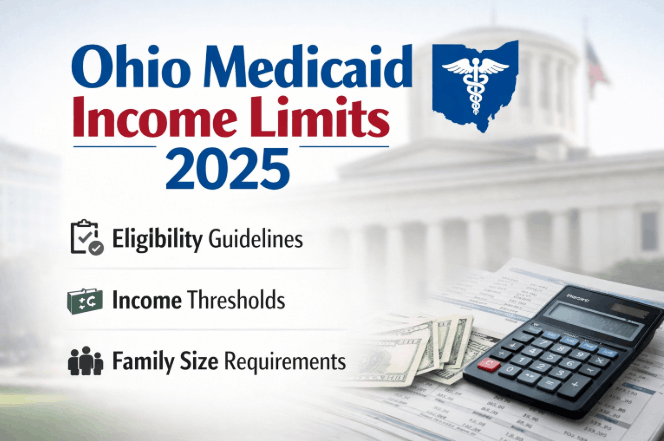
Ohio Medicaid Income Limits 2025: Full Eligibility Charts, Income Rules, And Asset Tests
Ohio Medicaid income limits for 2025 are set as a percentage of the Federal Poverty Level (FPL) and vary by eligibility group and household size. Adults ages 19–64 qualify at 138% FPL, approximately $1,800/month for a single person.
Children qualify up to 206% FPL. Pregnant women qualify up to 200% FPL. Figures are sourced from the Ohio Department of Medicaid 2025 Monthly Financial Eligibility schedule.
Key Takeaways
- A single adult ages 19–64 qualifies for Ohio Medicaid with monthly income up to approximately $1,800, equivalent to 138% of the Federal Poverty Level under ACA expansion rules.
- Children without insurance qualify at the highest threshold, up to 206% FPL, or $2,687/month for a household of one, making them eligible at incomes well above the adult limit.
- Seniors and people with disabilities applying for long-term care Medicaid face a separate Special Income Level of $2,901/month, plus an asset limit of $2,000 for an individual.
- No asset test applies to MAGI-based Ohio Medicaid programs covering adults, children, and pregnant women, only income determines eligibility for these groups.
What Is the Income Limit for Medicaid in Ohio in 2025?
Ohio Medicaid’s income limit for adults ages 19–64 is 138% of the Federal Poverty Level, approximately $1,800 per month for a single person, according to the Ohio Department of Medicaid 2025 eligibility schedule. The limit rises with each additional household member.
Ohio Medicaid income limits for 2025 are determined by the Ohio Department of Medicaid using Federal Poverty Level percentages under the Affordable Care Act expansion rules. A single adult qualifies with monthly income up to approximately $1,800.
Households of four qualify up to approximately $3,564/month. Limits are higher for children and pregnant women. These figures apply to MAGI-based programs, adults, children, and pregnant women.
The program covers more than three million Ohioans, roughly one in four state residents, according to the Health Policy Institute of Ohio.
Ohio adopted full Medicaid expansion under the Affordable Care Act, extending coverage to low-income adults who previously fell outside eligibility. Income is measured against the FPL using Modified Adjusted Gross Income rules.

Ohio Medicaid Income Limits 2025 Chart: All Eligibility Groups
The Ohio Department of Medicaid publishes a single monthly financial eligibility schedule covering all five MAGI-based coverage groups. The table below presents those figures directly from the 2025 ODM schedule, no rounding applied.
| Household Size | Parents/Caretakers (90% FPL) | Adults 19–64 (133% FPL) | Pregnant Women (156% FPL) | Children w/ Insurance (200% FPL) | Children w/o Insurance (206% FPL) |
|---|---|---|---|---|---|
| 1 | $1,174 | $1,735 | $2,035 | $2,609 | $2,687 |
| 2 | $1,587 | $2,345 | $2,750 | $3,525 | $3,631 |
| 3 | $1,999 | $2,954 | $3,465 | $4,442 | $4,575 |
| 4 | $2,412 | $3,564 | $4,180 | $5,359 | $5,520 |
| 5 | $2,824 | $4,173 | $4,895 | $6,275 | $6,464 |
| 6 | $3,237 | $4,783 | $5,610 | $7,192 | $7,408 |
Source: Ohio Department of Medicaid, 2025 Monthly Financial Eligibility, Children, Families, and Adults
Parents and caretaker relatives face the most restrictive threshold, 90% FPL, which sits below the adult expansion limit. The adults column shows 133% FPL, not 138%.
That gap has a specific federal calculation behind it, and it determines whether some applicants qualify or not.
For households larger than six, the ODM schedule extends through 12 members, each additional person adds approximately $412/month to the adults threshold.
Why Ohio Medicaid Income Limit Figures Differ Across Websites?
The Ohio Medicaid adult income limit appears as three different numbers on different websites, $1,735, $1,800, and occasionally $1,835. None of these figures is wrong. They reflect three different points in the same calculation.
The calculation runs in four steps:
- The Ohio Department of Medicaid publishes the adults threshold at 133% FPL, which is $1,735/month for a household of one, as shown in the ODM 2025 schedule.
- The Affordable Care Act requires a mandatory 5% income disregard to be applied on top of the stated FPL limit for MAGI-based programs.
- Adding the 5% disregard raises the effective qualifying threshold to 138% FPL, approximately $1,800/month for a single adult in 2025.
- The figure of $1,835/month reflects the 2026 FPL update, which took effect March 1, 2026, and applies to determinations made after that date, not to the 2025 eligibility period.
The most common mistake readers make is comparing their income against the 133% FPL figure from the ODM table and concluding they are over the limit.
Under Centers for Medicare & Medicaid Services rules, the 5% disregard is applied automatically during eligibility determination, you do not need to calculate it yourself.
If your income falls between $1,735 and $1,800/month as a single person, submitting an application is the right move regardless.

What Counts as Income for Ohio Medicaid Eligibility?
Ohio’s MAGI-based Medicaid programs measure income using Modified Adjusted Gross Income, broadly, the income figure from a federal tax return before certain deductions.
The specific sources that count, and those that do not, are defined by federal Medicaid rules administered through the Centers for Medicare & Medicaid Services.
Income sources that count toward the Ohio Medicaid limit:
- Wages, salaries, and tips from employment
- Net self-employment income
- Social Security benefits (retirement and disability, excluding SSI payments)
- Pension and retirement distributions
- Rental income net of allowable expenses
- Alimony received under agreements executed before January 1, 2019
Income sources that do not count:
- Supplemental Security Income (SSI) payments
- Child support received
- Federal and state tax refunds
- Certain veterans’ benefits and disability compensation
- Non-taxable disability payments received by children
One distinction matters here: child support paid out of the household reduces countable income, while child support received does not add to it.
ABD Medicaid applies different income counting rules, spousal income may be partially attributed to the applicant depending on household circumstances. Non-filers are assessed under a separate household composition rule, the county DJFS office applies it during the eligibility review.
How Ohio Determines Household Size for Medicaid?
Household size directly determines which dollar threshold applies on the income limits chart. Ohio uses the federal tax household rule for all MAGI-based Medicaid programs, the same rule used for marketplace health insurance eligibility.
Tax Household Rule: Who Is Included
Your household generally includes everyone listed on your federal tax return as a dependent or as a joint filer.
Children claimed as tax dependents are included in the household regardless of whether they live in the home full-time. Non-dependent adults living in the same residence are not counted unless they file taxes jointly with the applicant.
When Household Size Differs From Your Tax Return
Pregnant applicants add the expected number of children to their household count, a single pregnant woman expecting one child applies as a household of two.
Non-filers, including some children and low-income adults who are not required to file taxes, are assessed under a separate household composition rule applied by county Departments of Job and Family Services.
If your household composition is unclear, the DJFS office handling your case makes the formal determination, the county DJFS office makes the final call, not the applicant’s own household count.

Ohio Medicaid Income Limits for Seniors and People With Disabilities
Seniors ages 65 and older and people with disabilities qualify under Aged, Blind, or Disabled (ABD) rules, a separate framework from the MAGI system used for working-age adults and children. ABD programs apply both an income limit and an asset test.
The Special Income Level for long-term care Medicaid in Ohio is $2,901/month for 2025.
This threshold governs eligibility for Nursing Home Medicaid, the PASSPORT Waiver for home and community-based services, and the MyCare Ohio managed care program for dually eligible individuals.
Individuals receiving Supplemental Security Income automatically qualify for Ohio Medicaid without a separate income determination.
| Eligibility Group | Income Limit | Asset Test? | Asset Limit |
|---|---|---|---|
| Adults 19–64 (MAGI) | ~$1,800/mo (138% FPL) | No | None |
| Children (MAGI) | Up to $2,687/mo (206% FPL) | No | None |
| Pregnant Women (MAGI) | Up to $2,609/mo (200% FPL) | No | None |
| Seniors/ABD, Regular Medicaid | Linked to SSI benefit rate | Yes | $2,000 (individual) |
| Nursing Home / LTC Medicaid | $2,901/mo (Special Income Level) | Yes | $2,000 (individual) |
| PASSPORT Waiver | $2,901/mo (Special Income Level) | Yes | $2,000 (individual) |
Figures reflect 2025 Ohio Department of Medicaid and CMS standards. Verify current figures at medicaid.ohio.gov.
Seniors whose income exceeds $2,901/month may still have a pathway through Ohio’s Medically Needy spend-down program, that pathway is explained under spend-down rules below.
What Happens If Your Income Exceeds the Ohio Medicaid Limit?
An income figure above the published limit does not end eligibility, several pathways remain available. Which pathway applies depends on the eligibility group, and at least one applies in most cases.
Ohio’s Medically Needy spend-down pathway allows applicants whose income exceeds the Medicaid limit to deduct qualifying medical expenses from their countable income each month.
Once those expenses reduce countable income to the eligibility threshold, Medicaid coverage activates for the remainder of that month.
This pathway is separate from the 5% income disregard available to MAGI-category applicants near the cutoff.
The first pathway is the 5% income disregard, available to adults, children, and pregnant women under MAGI rules. If your income sits between the 133% FPL figure in the ODM table and the 138% FPL effective threshold, the disregard is applied automatically.
The second is the Medically Needy spend-down, primarily available to seniors and people with disabilities who exceed the ABD income limit but carry significant medical expenses.
The third is a marketplace plan through healthcare.gov, adults between 100% and 400% FPL qualify for premium tax credits that can substantially reduce monthly costs.
The One Big Beautiful Bill Act, signed July 4, 2025, introduced work reporting requirements for certain Medicaid expansion adults. Ohio-specific implementation timelines are published at medicaid.ohio.gov as ODM releases further guidance.
County DJFS offices make all final eligibility determinations, applying even when income appears borderline, is always the correct first step.

How to Apply for Ohio Medicaid in 2025?
Applying for Ohio Medicaid requires submitting an application through one of three official channels. County Departments of Job and Family Services process all applications and make the final eligibility determination.
- Gather documents: Proof of identity, Ohio residency, household income (pay stubs, Social Security award letters, pension statements), and Medicare card if applicable.
- Submit your application: Online at Ohio Benefits (benefits.ohio.gov), by phone at 1-800-324-8680, or in person at your county DJFS office.
- Await the eligibility determination: Most MAGI-based applications are processed within 30 days; LTC and ABD applications may take up to 45 days.
- Respond promptly to document requests: Incomplete documentation is the most common cause of processing delays.
- Confirm coverage start date: If approved, coverage may be backdated to the date your application was received
For details on processing timelines after submission, see how long does it take to get Medicaid.
Conclusion
Ohio Medicaid income limits 2025 set clear, group-specific thresholds that determine eligibility for more than three million Ohio residents. MAGI-based groups face no asset test, income alone determines coverage. Seniors and long-term care applicants follow separate ABD rules.
Apply at Ohio Benefits (benefits.ohio.gov) or contact the Ohio Department of Medicaid directly. Ohio Medicaid income limits for 2025 mean that coverage extends well beyond the lowest income brackets, reaching adults, families, and seniors across a wide range of financial circumstances.
FAQ
Does Ohio Medicaid have an asset limit?
No asset test applies to MAGI-based programs, adults, children, and pregnant women qualify on income alone. ABD and long-term care programs impose a $2,000 individual asset limit. Savings accounts, checking accounts, and most investments count toward that limit.
What income is not counted for Ohio Medicaid?
SSI payments, child support received, federal and state tax refunds, and certain veterans’ benefits are excluded under Modified Adjusted Gross Income rules. Non-taxable disability payments received by children are also excluded. Child support paid out reduces countable income.
Can you get Ohio Medicaid if you are working?
Yes. Earned wages count as income under MAGI rules, but employment alone does not disqualify you. If total household income stays within the applicable FPL threshold for your household size, you remain eligible regardless of employment status.
What is the highest income to qualify for Medicaid in Ohio?
Children without insurance qualify at the highest threshold, 206% FPL, or $2,687/month for a single-child household. Adults qualify at 138% FPL. For a state comparison, see Virginia Medicaid income limits 2025.
How does Ohio Medicaid handle postpartum coverage?
Ohio extends Medicaid coverage for 12 months after the end of pregnancy, regardless of income changes during that period. This postpartum coverage applies to women who were enrolled in pregnancy Medicaid and is administered by the Ohio Department of Medicaid.
Disclaimer: This article is for informational purposes only; official eligibility determinations must be verified directly with the Ohio Department of Medicaid or your county DJFS office.