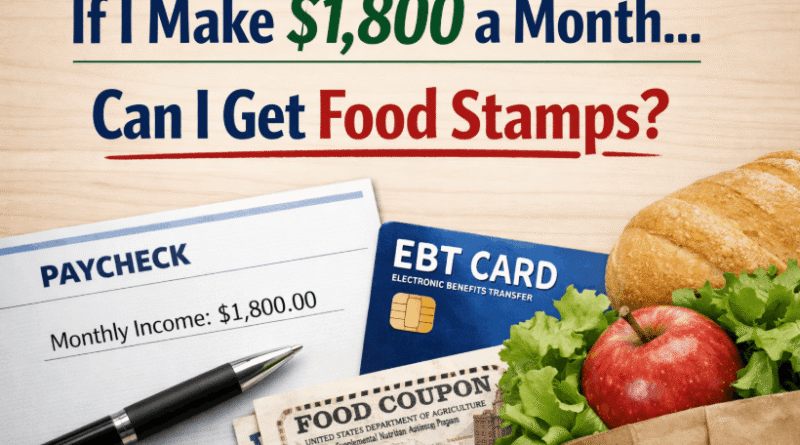
If I Make $1,800 a Month Can I Get Food Stamps? 2026 Limits
Eligibility at the $1,800 monthly income level is determined by state-specific application of federal poverty guidelines.
While you exceed the Federal Gross Income Limit of $1,696 for a household of one, you likely qualify in the 44 states using Broad-Based Categorical Eligibility (BBCE), where limits range from $2,152 to $2,610.
To maintain eligibility, your net income after mandatory deductions, such as shelter and the 20% earned income credit, must fall below $1,305 per month.
Key Takeaways:
- The BBCE Advantage: Most residents qualify at $1,800 because their states bypass federal strict limits in favor of higher state thresholds (165%–200% of the Federal Poverty Level).
- The Net Income Pivot: Your gross pay is only the starting point; the USDA determines actual benefit amounts based on your net income after deductions.
- 2026 Work Mandates: Under the One Big Beautiful Bill (OBBB) Act, able-bodied adults up to age 64 must meet specific work requirements to remain eligible.
- Excluded Deductions: As of the 2026 fiscal year, internet service fees are no longer an allowable utility deduction under federal guidelines.
If I make $1,800 a month can I get Food Stamps?
Yes, you can receive food stamps, making $1,800 a month if you live in a state that applies Broad-Based Categorical Eligibility (BBCE).
In these states, the gross income limit for a single person is typically $2,152 (165% FPL) or $2,610 (200% FPL). However, if you live in a strict state like Mississippi or Wyoming, $1,800 exceeds the $1,696 maximum, resulting in an automatic denial.
Is $1,800 Over the 2026 SNAP Limit?
An $1,800 gross income represents a critical cliff in the SNAP regulatory framework. This figure sits precisely between the standard federal ceiling and the expanded thresholds adopted by most state agencies.
The USDA Food and Nutrition Service (FNS) establishes a federal ceiling of 130% of the FPL. For a household of one in 2026, that ceiling is $1,696. If your state follows strict federal guidelines, an income of $1,800 triggers an over-income rejection before any deductions are even considered.
However, the majority of the U.S. utilizes BBCE. This policy allows states to align SNAP eligibility with other low-income assistance programs, effectively raising the gross income gate.
If you are in a BBCE state, the agency moves past your $1,800 gross pay to calculate your Net Income, which is the true determinant of your monthly EBT allotment.
How the OBBB Act Changes Your Eligibility – 2026 SNAP Rules
The One Big Beautiful Bill (OBBB) Act introduced the most significant administrative changes to SNAP in over a decade. Two critical shifts affect those earning $1,800 a month:
Why You Can No Longer Deduct Internet Costs
Previously, many states allowed internet costs to be bundled into the Standard Utility Allowance (SUA) or shelter costs.
Per the latest August 2025 USDA Memo, internet fees are now explicitly excluded. Applicants relying on high-speed data costs to lower their net income may find themselves unexpectedly ineligible.
Beyond utility adjustments, the OBBB Act significantly tightened labor participation requirements for older applicants.
ABAWD Age Limits Increase to 64
The definition of Able-Bodied Adults Without Dependents (ABAWD) has been expanded. Work requirements that previously ended at age 54 now extend to age 64. If you earn $1,800 through part-time work totaling less than 80 hours per month, you may lose benefits regardless of your income level.

How to Calculate Your Net Income: The $1,800 Breakdown
Determining net eligibility requires a sequential audit of income consistent with USDA and SSA verification protocols.
For an applicant wondering if I make $1,800 a month can I get food stamps, agencies do not simply subtract expenses from gross pay; they follow a standardized calculation to reach the final allotment figure.
- 20% Earned Income Deduction: The agency first excludes $360 from your $1,800 earnings to account for taxes and work-related costs, leaving an adjusted balance of $1,440.
- Standard Deduction: Every household of one gets a flat deduction (currently $209 for FY 2026). (Remaining: $1,231)
- Excess Shelter Deduction: This is the most complex step. You subtract your shelter costs (rent/mortgage + utilities) that exceed half of your adjusted income. Note that this deduction is capped at $744 unless a household member is elderly or disabled.
To receive any benefits, your final Net Income must be lower than $1,305 for a household of one. To verify your specific eligibility based on 2026 cost-of-living adjustments, use the official USDA SNAP Estimator to run a personalized calculation.
SNAP Eligibility Myths: The Truth About Assets and Savings in 2026
| Myth | What Is Actually True |
| I can’t get SNAP if I own a car. | Most states exclude one vehicle entirely from asset tests. |
| If I have $5,000 in savings, I’m disqualified. | 36 states have eliminated the asset test for most households. |
| Homeowners cannot apply. | Your primary residence is an excluded asset in all 50 states. |
| I make too much at $1,800. | In states utilizing a 200% FPL threshold, an $1,800 income falls substantially below the maximum allowable limit. |
| Internet bills lower my net income. | The OBBB Act of 2025 removed the internet as a deductible utility. |
| Only citizens get food stamps. | Qualified non-citizens (LPRs) are eligible after 5 years or immediately if disabled. |
Does Your State Use Broad-Based Categorical Eligibility (BBCE)?
Your success at the $1,800 income level depends on your geography. SNAP income limits 2026 are tiered based on state policy choices.
- 200% FPL States ($2,610 Limit): States like California, New York, and Massachusetts allow the highest gross incomes. If you live here, the answer to if I make $1,800 a month can I get food stamps is generally yes.
- 165% FPL States ($2,152 Limit): States like New Jersey or Wisconsin provide a middle-ground threshold. You remain eligible here.
- 130% FPL States ($1,696 Limit): In states like Texas (for some households), Mississippi, and Tennessee, $1,800 is an automatic disqualifier unless a household member is elderly or disabled.
2026 SNAP Income Limits and Monthly Payment Chart
| Household Size | Gross Limit (130% FPL) | Gross Limit (200% BBCE) | Max Monthly Allotment |
| 1 Person | $1,696 | $2,610 | $298 |
| 2 People | $2,298 | $3,534 | $546 |
| 3 People | $2,901 | $4,458 | $782 |
| 4 People | $3,503 | $5,382 | $993 |
What Disqualifies You From Food Stamps at $1,800/Month?
Even if you meet the income test, other regulatory barriers exist. What disqualifies you from food stamps often involves Administrative Non-Compliance.
- The Self-Employment Gross-Up: If your $1,800 comes from 1099 work, agencies may apply a standard expense ratio that overestimates your gross income if you cannot provide itemized IRS-compliant records.
- The ABAWD Time Limit: If you are not working at least 20 hours a week and do not meet an exemption, you are limited to 3 months of SNAP in a 3-year period.
- Transfer of Assets: If you gave away property or cash to drop below asset limits, you face a disqualification period of up to 10 years.
This is similar to other assistance programs where financial history is audited; for instance, understanding what is the 7 year look-back period for Medicaid is vital for those managing long-term financial eligibility and asset transfers.

What is the Income Limit for One Person on SNAP in 2026?
The 2026 income limit for a single person is not a single number. It is a three-tiered system. The Federal Gross Limit is $1,696, which applies in states with no expanded eligibility. However, under Broad-Based Categorical Eligibility, most Americans fall under a $2,152 or $2,610 threshold.
According to USDA guidelines, once you pass the gross income test, you must also pass the Net Income Test of $1,305.
This ensures that while a person can ask if I make $1,800 a month can I get food stamps, they are only eligible if their non-discretionary expenses (housing and utilities) leave them with insufficient funds to purchase a nutritionally adequate diet.
What Bills Does SNAP Take Into Consideration for Deductions?
The SNAP deduction framework prioritizes non-discretionary shelter and health-related expenditures. The agency considers:
- Legally Obligated Child Support: This is deducted from your gross income first.
- Medical Expenses: Only for elderly (60+) or disabled members, exceeding $35/month.
- Shelter Costs: Rent, mortgage interest, property taxes, and the Standard Utility Allowance (SUA).
- The Earned Income Deduction: 20% of all wages is excluded to account for taxes and work-related expenses.
For those calculating if I make $1,800 a month, can I get food stamps, the Earned Income Deduction (20%) is the first critical reduction. However, federal guidelines exclude personal debt, such as car payments or credit card interest, from the final deduction calculation.
Conclusion
Securing SNAP benefits at $1,800 requires precise alignment with state-level expansions of federal baselines. While you technically exceed the federal gross limit, the prevalence of BBCE means the majority of $1,800 earners will qualify for at least the minimum allotment after deductions.
For low-income workers in 2026, the question if I make $1,800 a month can I get food stamps requires a state-specific net audit to confirm benefit eligibility.
FAQ
Can I get SNAP if I own a home?
Yes. Your primary residence is an excluded resource in all 50 states. Owning a home does not impact your eligibility as long as your monthly income, such as $1,800, meets the state-specific gross and net income requirements.
Do seniors on Social Security get food stamps?
Yes. Seniors (age 60+) and individuals with disabilities have a higher probability of qualifying at $1,800 because they are exempt from the Gross Income Test entirely. They only need to pass the Net Income Test ($1,305), and unlike other applicants, they can deduct uncapped out-of-pocket medical expenses.
Does the 2026 COLA increase affect my eligibility?
No, it typically protects it. For FY 2026, the gross income limit for a single person increased to $1,696, ensuring that small cost-of-living increases don’t immediately cause a benefit cliff for those wondering if I make $1,800 a month can I get food stamps.
Can I include my internet bill in my utility deductions?
No. Per Section 10104 of the One Big Beautiful Bill (OBBB) Act, internet service fees are explicitly prohibited from being included in shelter or utility deductions as of October 2025. You should look into the FCC Lifeline Program for separate internet assistance.
What is the 2026 work requirement for a 60-year-old?
Under the new OBBB mandates, the ABAWD (Able-Bodied Adults Without Dependents) work requirements now extend to individuals up to age 64. If you are 60, you must now document at least 80 hours of work or approved training per month to receive benefits for more than three months, unless you meet a specific medical exemption.
Are there specific food restrictions on my EBT card?
Restrictions vary by state based on active USDA waivers. Starting January 1, 2026, several states (including Indiana, Iowa, and Utah) implemented SNAP Food Restriction Waivers that prohibit using EBT for non-nutritional items like soda and candy. Check your local state agency for the Banned Items list.
Can I get food stamps if I have $5,000 in a savings account?
Yes, in most cases. Currently, 36 states utilize Broad-Based Categorical Eligibility (BBCE) to eliminate the asset test entirely for most households. If you live in a state with an asset test, the 2026 limit is typically $3,000, or $4,500 if the household includes a member who is elderly or disabled.
What if my $1,800 income is from self-employment?
If you are self-employed, the agency will deduct 20% of your gross income automatically to cover business expenses and taxes.
However, you must provide a Schedule C or verified profit-and-loss statement. Failure to provide IRS-aligned documentation may result in the agency grossing up your income and denying your claim.
Is the Simplified Reporting threshold different in 2026?
Yes. You must notify your caseworker if your monthly income rises above $1,696. Even if the answer to if I make $1,800 a month can I get food stamps is yes in your state, you must report crossing that federal threshold.