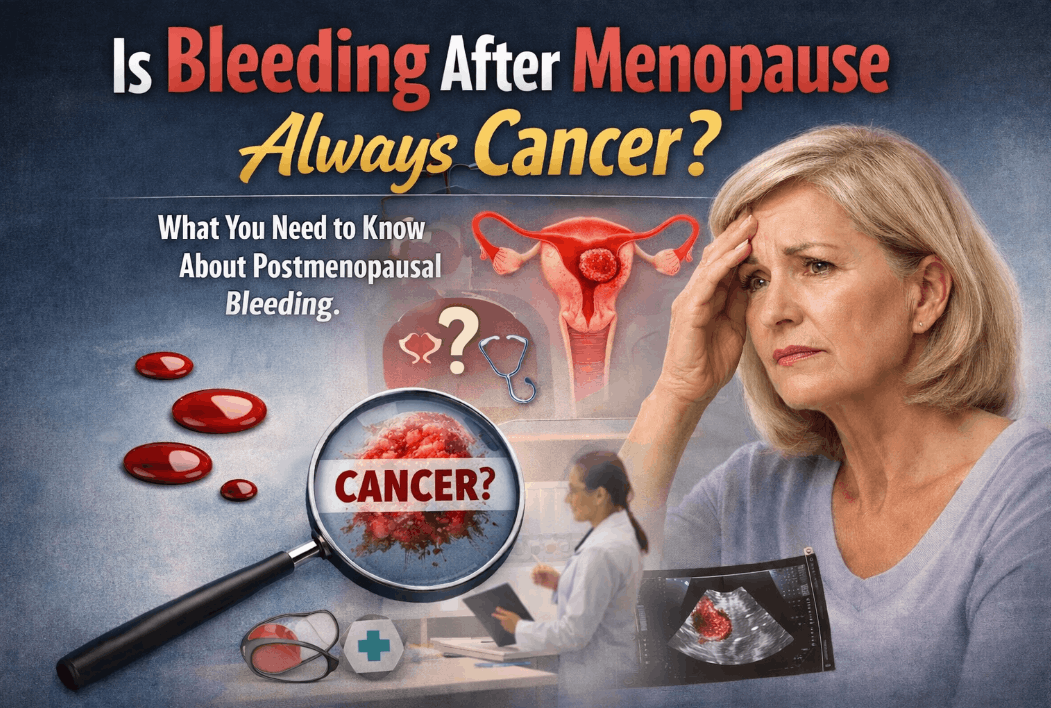
Is Bleeding After Menopause Always Cancer? Causes, 4mm Rule, And The 10% Risk Statistics
The discovery of vaginal spotting years after your period has ended is often met with immediate fear, leading many to wonder is bleeding after menopause always cancer.
Statistically, the answer is no; only about 10% to 15% of women with postmenopausal bleeding are diagnosed with a malignancy.
However, because nearly 90% of women with endometrial cancer present with bleeding as their first symptom, medical guidelines in 2026 dictate that any amount of blood must be treated as a high-priority diagnostic event until proven otherwise.
Is bleeding after menopause always cancer and why is it a red flag?
While the majority of cases are caused by benign conditions like tissue thinning or non-cancerous growths, medical professionals treat postmenopausal bleeding as a guilty until proven innocent symptom.
This is because the uterus is expected to be dormant after menopause; any shedding of the lining indicates a physiological change that requires a clinical explanation.
The Truth of Postmenopausal Bleeding
In clinical practice, normal bleeding does not exist after you have gone 12 consecutive months without a period. Even if you only experience a single wipe of pink discharge or a brown stain that never returns, it counts as postmenopausal bleeding (PMB).
The urgency isn’t necessarily because you have cancer, but because early-stage uterine cancer is highly curable if caught the moment that first drop of blood appears. Waiting to see if it happens again is the most common mistake patients make.

Why people search for is bleeding after menopause always cancer
The high search volume for this specific phrase stems from a mix of biological alarm and the silent nature of gynecological health. Many women are blindsided by spotting because they were told menopause was the end of their concerns.
Seeing unexpected blood usually triggers an immediate need for clinical data to weigh the likelihood of a minor issue against the need for urgent diagnostic action.
- Reassurance: Seeking data to prove that your symptoms could be something minor.
- Clarification: Understanding what abnormal looks like when your baseline has been zero for years.
- Action: Determining if you need an emergency room visit or just a routine appointment.
This widespread concern stems from the fact that blood remains a universal indicator of physical distress, particularly when it occurs after years of hormonal dormancy.
Normal vs abnormal bleeding after menopause
To be clinically precise, there is no normal bleeding once you are in menopause. However, there is a distinction between benign (non-harmful) causes and abnormal (potentially malignant) causes.
Differentiating between these specific physical signs provides your medical team with the precise context needed to prioritize your screening.
Symptom Comparison Table
| Feature | Benign Pattern (Non-Cancerous) | Abnormal/High-Risk Pattern |
| Color | Pink, light brown, or pale red | Bright red or dark, heavy clots |
| Frequency | One-time spotting or after intercourse | Persistent, daily, or worsening |
| Pain | Often painless or mild dryness | Pelvic pressure or deep cramping |
| Tissue | Usually just liquid/staining | May include small fleshy bits |
| Trigger | Often follows exercise or intimacy | Occurs spontaneously without trigger |
Why do I have blood after my menopause?
If your doctor determines the cause is not cancer, it is usually due to one of several physiological changes. A common pattern in aging is the drying out of estrogen-dependent tissues.
- Vaginal and Endometrial Atrophy: As estrogen levels plummet, the lining of the vagina and uterus becomes thin and brittle. Like chapped lips that crack and bleed, these tissues can bleed from simple friction or even spontaneously.
- Endometrial Polyps: These are teardrop-shaped growths in the uterine wall. While they are almost always benign, they are highly vascular and can bleed easily.
- Endometrial Hyperplasia: This is a condition where the uterine lining becomes too thick. This is often seen in women with higher BMI or those on unopposed estrogen therapy. If left untreated, it can lead to cancer.
- The Obesity-Estrogen Connection: In the US, obesity is a leading driver of postmenopausal bleeding. Fat cells produce a type of estrogen called estrone. If you have excess fat tissue, your uterus continues to be stimulated by estrogen without the balancing effect of progesterone, leading to thickened linings and bleeding.
Do I feel cramping or pain while having bleeding after menopause?
Many patients assume that if the bleeding isn’t painful, it isn’t serious. This is a dangerous myth. In fact, early-stage endometrial cancer is frequently painless.
Cramping or pelvic pain is more commonly associated with:
- Cervical Stenosis: When the opening of the cervix narrows, trapped blood can cause cramping as the uterus tries to expel it.
- Large Polyps or Fibroids: These can cause a heavy feeling or dull ache in the pelvis.
- Infection: Pelvic inflammatory disease or severe vaginal infections can cause both burning and bleeding.
If you are concerned that your postmenopausal spotting might be cancer and you also feel sharp pelvic pain, it may indicate a secondary complication such as an ovarian cyst.
How many days can I have bleeding after menopause?
The duration of the bleeding often points toward the cause, but it is not a perfect diagnostic tool.
- 1–2 Days: Often associated with atrophy or a one-off tear in the vaginal wall.
- 3–7 Days: Mimics a period; this is frequently caused by endometrial hyperplasia or a reaction to HRT changes.
- Persistent/Intermittent: Bleeding that stops and starts over several weeks is a classic hallmark of polyps or malignancy.
Regardless of whether it lasts for five minutes or five days, the diagnostic process remains the same. Do not wait for the bleeding to reach a certain day count before seeking help.
Which doctor do I need to consult for this issue?
Securing a definitive answer requires a structured approach to the current healthcare landscape. For many, the first challenge is physically reaching a specialist, especially if mobility or distance is a concern.
In these cases, searching for non-emergency medical transportation can provide a reliable way to get to your appointment safely. Once you have secured transit, you should choose the provider that best fits your current diagnostic stage.
- Primary Care Physician (PCP): You can start here for a referral, but they often lack the specialized ultrasound equipment needed for a deep look.
- Gynecologist (OB-GYN): This is the gold standard for your first visit. They can perform pelvic exams, transvaginal ultrasounds, and biopsies in the office.
- Gynecologic Oncologist: You only need this specialist if a biopsy or scan suggests that the bleeding is related to cancer. They are surgeons specifically trained in treating female reproductive cancers.
How to approach a doctor regarding bleeding after menopause
When calling for an appointment, do not be vague. Being direct ensures you are triaged correctly. Using specific clinical terminology when speaking with your provider ensures your concerns are triaged with the appropriate level of urgency.
- State the urgency: Tell the receptionist, “I am postmenopausal and experiencing vaginal bleeding. I need an urgent evaluation.”
- Track your stats: Note the date the bleeding started, the color (bright red vs. brown), and any medications you take (especially blood thinners or Tamoxifen).
- Ask for a Transvaginal Ultrasound: This is the first-line imaging tool used in 2026 to measure the uterine lining.
- Discuss the 4mm Rule: Ask your doctor, “What was my endometrial thickness?” A measurement under 4mm is highly reassuring; anything over 4mm requires a biopsy.
- Request a Biopsy if bleeding continues: Even if an ultrasound looks normal, if you continue to bleed, a tissue sample is necessary for 100% certainty.
- Review your HRT: If you are on hormone therapy, ask if your dosage needs adjustment to prevent breakthrough bleeding.

Managing Postmenopausal Spotting and Tissue Discomfort
It is critical to understand that there is no home remedy to stop or cure the underlying cause of postmenopausal bleeding. Because the cause could be a serious medical condition, attempting to wait it out with herbal teas or supplements is dangerous.
However, if your doctor has already diagnosed you with Vaginal Atrophy, you can manage the discomfort at home using:
- Water-based lubricants: To prevent tearing during intimacy.
- Vaginal moisturizers: Applied regularly (not just during sex) to restore tissue elasticity.
- Hyaluronic acid inserts: These are non-hormonal options that help retain moisture in the vaginal walls.
While these topical aids improve daily quality of life, they are strictly palliative and do not address the underlying pathology of hyperplasia or malignancy.
The Diagnostic Roadmap: What to expect
Once you are in the office, the doctor will likely follow a specific sequence. A common pattern in 2026 is the use of high-resolution imaging followed by a pipelle biopsy.
The 4mm Rule Explained
The endometrial stripe is the thickness of the lining of your uterus. In a postmenopausal woman, this lining should be very thin because there is no estrogen to grow it.
- 4mm or less: The risk of cancer is less than 1%.
- Greater than 4mm: The lining is thickened, which could be hyperplasia or a tumor. A biopsy is mandatory.
Medication Checklist
Check if you are taking any of the following, as they are known triggers for non-cancerous bleeding:
- Blood Thinners (Warfarin, Eliquis): Can make minor atrophy bleed more visibly.
- Tamoxifen: Used for breast cancer, it can cause the uterine lining to thicken.
- Ginkgo Biloba or Garlic Supplements: High doses can increase bleeding tendencies.
Final Summary and Next Steps
While the fear that postmenopausal bleeding is always cancer is understandably profound, current medical data provides a much more nuanced and often reassuring perspective.
Most of the time, your body is simply reacting to the natural thinning of tissues that occurs with age. However, you cannot diagnose yourself from home.
For official 2026 clinical classifications, refer to the National Cancer Institute’s guide on endometrial standards to understand how doctors categorize uterine changes and treatment paths.
Your Immediate Action Plan:
- Don’t Panic: Remember the 10% rule; it is more likely to be a benign issue.
- Don’t wait: Call an OB-GYN today. A one-time spot is just as important as a heavy flow.
- Prepare for a Scan: Drink plenty of water before your appointment if they are doing a pelvic ultrasound.
- Get a Clear Answer: Do not leave the office until you know the thickness of your uterine lining (the 4mm rule).
Ultimately, the most effective way to protect your long-term health is to replace uncertainty with clinical facts through immediate screening.
FAQ
Is pink discharge the same as bleeding?
Yes. Any color that isn’t clear or white, including pink, brown, or rust, is considered bleeding in a postmenopausal woman and requires a medical evaluation.
Can a UTI cause vaginal bleeding?
No, but it can cause blood in your urine (hematuria). Because the openings are close together, it can be hard to tell the source. A doctor will perform a dipstick test to see if the blood is coming from your bladder or your uterus.
What if my ultrasound was normal but I am still bleeding?
An ultrasound can occasionally miss small polyps or early-stage cancers. If bleeding persists, you should request an endometrial biopsy or a hysteroscopy (a camera inside the uterus) for a direct look.
Can exercise trigger postmenopausal bleeding?
Yes, if you have severe vaginal atrophy. The friction from walking or running can cause the thin vaginal walls to tear slightly. However, you must still rule out internal uterine causes first.
Does HRT always cause spotting?
It is common during the first 3–6 months of a new regimen. However, if you have been on a stable dose for years and suddenly start bleeding, it is not the HRT; it is something else that needs checking.
Is bleeding a side effect of the flu or COVID-19?
While some women report cycle changes after viral infections, there is no clinical evidence that these viruses cause postmenopausal bleeding. Do not attribute spotting to a virus; see a doctor.
What is the survival rate if it is cancer?
If caught at Stage 1 because you reported the bleeding immediately, the 5-year survival rate for endometrial cancer is over 95%. This is why reporting the first drop is so vital.
Medical Disclaimer: This information is for educational purposes only and does not constitute professional medical advice, diagnosis, or treatment. Every clinical case is unique; the statistics and diagnostic rules mentioned should not be used to self-diagnose or delay an urgent consultation.
Always seek the advice of a licensed physician regarding any postmenopausal spotting. Reliance on any information provided in this article is solely at your own risk.