HMRC Warns That Savings Over £3,501 May Incur Tax: Are Your 2026 Interest Earnings Safe?
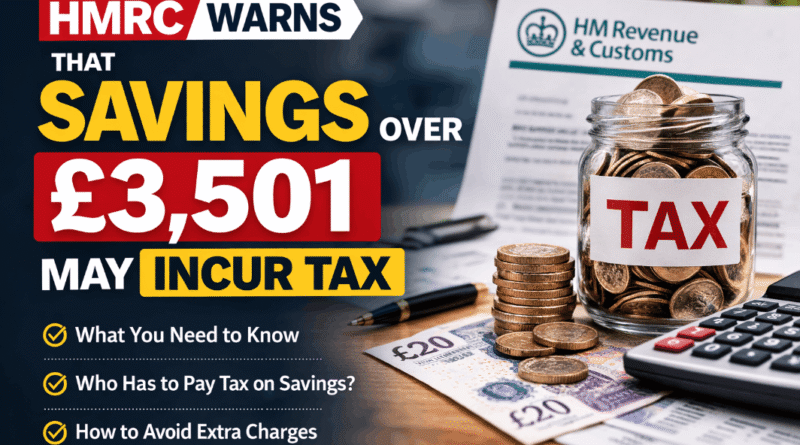
With UK interest rates remaining higher than the record lows of the last decade, millions of savers are waking up to a new financial reality. HMRC warns that savings over £3,501 may incur tax for many individuals, particularly as high yields collide with frozen thresholds for the first time in years.
For a long period, the Personal Savings Allowance (PSA) acted as a sturdy shield, keeping almost all modest savings pots tax-free. However, this combination of stagnant tax brackets and higher interest rates has created a perfect storm for the 2025/26 tax year.
Quick Summary: Savings Tax at a Glance
- HMRC Focus: Tax is charged on interest earned, not your total savings balance.
- Tax-Free Limits: Most adults have a Personal Savings Allowance (PSA) of £1,000 (Basic Rate) or £500 (Higher Rate).
- The £3,501 Trigger: At current rates of 5.5%, a balance above £9,000 typically exhausts the Higher Rate allowance.
- Data Sharing: Banks report your interest to HMRC automatically; you don’t always need to file a return.
Why £3,501 Savings May Trigger Tax?
A saver earning 5.5% interest on £3,501 will generate approximately £192 annually. While this is below the £500 limit for higher-rate taxpayers, when combined with interest from other accounts or a small pay rise, it frequently pushes savers into a taxable position.
This transition is occurring alongside a UK interest rate forecast for next 5 years, that points to a sustained period of higher yields, effectively ending the era of ‘tax-free by default’ for modest savers.
HMRC is now increasingly active in monitoring these accounts, issuing nudge letters to those whose interest earnings have quietly breached their tax-free limits. If you have been diligent about building your retirement fund or emergency pot, you may now be in the danger zone for an unexpected tax bill.
HMRC Warns That Savings Over £3,501 May Incur Tax
HMRC has signalled that savers with balances as low as £3,501 in high-interest accounts could be liable for tax in the 2025/26 tax year.
While the tax is levied on the interest earned rather than the total balance, higher-rate taxpayers (40%) hit their £500 Personal Savings Allowance once they earn interest on a balance exceeding £3,500 at a 5.5% rate.
HMRC is using automated data sharing with banks to detect these breaches and adjust tax codes or issue bills accordingly.
What is the Personal Savings Allowance (PSA)?
The Personal Savings Allowance is the specific amount of savings interest you can earn each year without paying a penny in tax. According to current HMRC guidance for the 2025/26 tax year, your allowance depends on your income bracket:
- Basic-rate taxpayers: £1,000 tax-free interest.
- Higher-rate taxpayers: £500 tax-free interest.
- Additional-rate taxpayers: £0 (all interest is taxable).
Why £3,500 is the Danger Zone?
One of the most common points of confusion is whether HMRC is taxing your capital balance or your interest. To be clear: HMRC does not tax your initial savings; they tax the profit (interest) those savings generate.
The reason the figure £3,501 is currently making headlines is due to the math behind the Higher Rate (40%) tax bracket.
- Higher Rate Savers: If you earn over £50,270, your tax-free allowance for interest is just £500.
- The Math: The current market conditions in 2026 see typical easy-access rates sitting between 4% and 5%, while fixed-term bonds are frequently reaching 5.5% to 5.7%.
- The Tipping Point: A balance of £3,501 at 5.5% AER generates approximately £192.50 in interest. While this is under the £500 limit on its own, most savers have multiple pots. If you have other interest-bearing assets, this specific balance can be the one that finally pushes you over the edge.
Why the £3,501 Figure is Often Misunderstood
It is a common misconception that £3,501 is a fixed legal threshold. In reality, it is a variable “tipping point.”
- It’s Rate-Dependent: The £3,501 figure assumes a high-yield rate of roughly 5.5%. If rates drop to 2%, you would need a balance of £25,000 to hit the same tax trigger.
- Cumulative Total: HMRC doesn’t just look at one account; they aggregate interest from all Easy Access, Fixed Bond, and Regular Saver accounts.
For Basic Rate (20%) taxpayers, the danger zone is higher, around £18,000 to £20,000, because you have a larger £1,000 allowance.
For instance, someone earning a typical UK salary of 40k after tax UK generally falls into this basic rate category, providing significantly more breathing room before the taxman intervenes.
Understanding Your Allowances: Pensioners & Employees
The Personal Savings Allowance (PSA) depends entirely on your total adjusted net income for the tax year.
For those whose income has grown toward 50k after tax UK, staying aware of your total gross earnings is vital, as breaching the £50,270 threshold instantly slashes your savings allowance in half.
| Income Tax Band | Annual Income | Savings Allowance (PSA) |
| Basic Rate (20%) | £12,571 to £50,270 | £1,000 |
| Higher Rate (40%) | £50,271 to £125,140 | £500 |
| Additional Rate (45%) | Over £125,140 | £0 |
Does this apply to Pensioners?
Yes. Pensioners are subject to the same PSA rules as employees. However, many retirees can also benefit from the Starting Rate for Savings.
If your non-savings income (like your state or private pension) is less than £17,570, you may be eligible for an additional £5,000 of tax-free savings interest. This is a critical buffer that often keeps lower-income pensioners safe from the £3,501 trap.
How HMRC Knows: Automation and Nudge Letters
HMRC monitors these earnings through the Connect system, a sophisticated data-matching tool that cross-references bank records with individual tax files.
- Bank Reporting: Every year, UK banks and building societies are legally required to send a report of all interest paid to customers directly to HMRC.
- Data Matching: HMRC’s system matches this data against your National Insurance number.
- The Nudge Letter: If the system flags that you have earned more interest than your allowance, you will receive a One-to-Many (nudge) letter.
While a nudge letter is not an official tax bill, it serves as a formal request to review your records; ignoring it can lead to detailed enquiries and penalties.
How to Verify the Data
You should regularly log in to your Personal Tax Account on the Gov.uk website. Here, you can see exactly what interests your banks have reported. If the figures are wrong for example, if they have included interest from an ISA (which should be tax-free), you can dispute it immediately.
How You Pay
For most people, paying this tax does not require a cheque or a Self-Assessment return.
- PAYE Adjustments: If you are an employee or receive a pension, HMRC will typically adjust your tax code (P800). This means they will take the tax you owe on your savings out of your monthly pay or pension over the following year.
- Self-Assessment: You only need to manually report interest if your total savings income exceeds £10,000 or if you are already self-employed.
- The Error Fix: If you notice your take-home pay has dropped unexpectedly, check your tax code. HMRC often estimates your current year’s interest based on last year’s. If you have spent your savings and are earning less interest now, you must tell HMRC to fix your code.
The Hidden Tax Traps Most Savers Overlook
There are several scenarios where savers get caught out, even with modest balances.
The Fixed-Term Crystallisation Trap
If you put £10,000 into a 3-year fixed-rate bond that pays all the interest at the end of the term, you will be taxed on the total 3-year interest lump sum in the year you receive it.
Even if you were under the limit in years 1 and 2, the crystallised interest in year 3 could be £1,500+, triggering a large, unexpected tax bill.
The Joint Account Headache
Interest on joint accounts is split 50/50 by default. If you are a Higher Rate taxpayer and your partner is a Basic Rate taxpayer, you might want to move the savings into their name to utilise their larger £1,000 allowance.
The Child Benefit Link
Savings interest counts toward your Adjusted Net Income. If your salary is £59,500 and you earn £1,000 in savings interest, your total income becomes £60,500.
For higher earners, such as those reaching 80k after tax UK, the combination of high interest and the loss of child benefit can create a significant ‘effective’ tax rate on every extra pound saved.
This could trigger the High Income Child Benefit Charge, forcing you to pay back a portion of your benefit.
How to Protect Your Savings
If you are nearing the £3,500–£10,000 balance range, consider these legitimate ways to reduce your tax exposure:
- The ISA Swap: You can move up to £20,000 per year into a Cash ISA. All interest earned inside an ISA is 100% tax-free and does not count toward your PSA.
- Premium Bonds: While the prizes are not guaranteed, any winnings from NS&I Premium Bonds are tax-free. For Higher Rate taxpayers, the tax-free nature of Premium Bonds often makes them more attractive than a 5% taxable account.
- Pension Contributions: If you are on the edge of the Higher Rate tax band, putting more money into your pension can lower your taxable income, potentially moving you back to the Basic Rate and doubling your PSA from £500 to £1,000.
- Monthly Interest: Choosing a monthly payout rather than an annual one can help spread the interest across two different tax years, preventing a single lump sum from breaching your allowance.
Who is Most Affected by the Savings Tax?
While any saver can be hit, HMRC data suggests the following groups are most at risk:
- Retirees: Those holding large cash buffers for living expenses.
- Higher Earners: Anyone earning over £50,270 whose allowance is cut to £500.
- Couples: Those with joint accounts where interest is split 50/50.
Typical Savings Accounts Targeted
Taxable interest is not just limited to standard bank accounts. HMRC tracks:
- Easy-access savings and High-interest current accounts.
- Fixed-rate bonds and Regular savers.
- Peer-to-peer (P2P) lending returns.
Your Savings Tax Planning Checklist
Before the tax year ends on April 5th, ensure you have taken these steps:
- Calculate your total expected interest for the year.
- Maximise your £20,000 ISA allowance to shield future interest.
- Review joint accounts to see if moving funds to a lower-earning partner saves tax.
- Check your tax code on the HMRC app to ensure estimations are accurate.
These rules are based on current HMRC Personal Savings Allowance guidance for the 2025/26 tax year.
FAQ about HMRC warns that savings over £3,501 may incur tax
Is the £3,501 limit based on my balance or my interest?
It is based on the interest earned. However, with interest rates around 5–6%, a balance of just £3,501 can generate enough interest to use up a significant portion of a Higher Rate taxpayer’s £500 allowance, especially when combined with other accounts.
Does the Personal Savings Allowance apply to pensioners?
Yes, pensioners receive the same £1,000 or £500 allowance. Many also qualify for the Starting Rate for Savings, which allows up to £5,000 of interest tax-free if their pension income is low.
How does HMRC know how much interest I have earned?
UK banks and building societies are legally required to report all interest paid to HMRC annually. HMRC uses its Connect system to link this data to your National Insurance number.
What is an HMRC nudge letter?
It is an informal letter from HMRC suggesting they have data showing you may have unpaid tax on savings. It is a nudge for you to check your tax return or tax code for errors.
Do I need to report interest from easy-access accounts every month?
No. Banks report the total for the tax year once it ends. You only need to act if you are in Self-Assessment or if you receive a tax code change letter (P800) that you believe is incorrect.
What happens to joint account interest?
HMRC splits the interest 50/50 between the two account holders. If one partner is in a higher tax bracket, they will use up their £500 allowance much faster than the partner in the basic bracket.
How can I spot a Savings Tax scam?
Legitimate HMRC letters will never ask for immediate payment via a link, nor will they ask for your bank details via text or email. Always log in to your official Government Gateway account to verify any claims.
What savings accounts are tax-free in the UK?
ISAs (Individual Savings Accounts) and NS&I Premium Bonds are the primary tax-free options. Interest or winnings from these do not count toward your PSA.
Does ISA interest count towards my PSA?
No. ISA interest is entirely ring-fenced and ignored by HMRC when calculating if you have exceeded your £500 or £1,000 limit.
Can HMRC automatically deduct savings tax?
Yes. For most employees and pensioners, HMRC adjusts your tax code so the money is taken directly from your wages or pension via PAYE.
Conclusion
The £3,501 warning is a reminder that in an era of higher interest rates, passive saving requires active management. The days of ignoring tax on bank interest are over for many UK residents.
- Check your total interest across all non-ISA accounts.
- Log in to your Personal Tax Account to see what HMRC thinks you’ve earned.
- If you are nearing your limit, consider moving funds into a Cash ISA or Premium Bonds before the April 5th deadline.