Australia Retirement Age Increase 2026: New Pension Rates, Deeming Rules, And Eligibility Guide
If you are planning for your future this year, the most pressing question is whether a further Australia retirement age increase is on the cards.
While many seniors are concerned about shifting eligibility, the official age has remained stable at 67 since mid-2023, though the financial landscape surrounding it has become significantly more complex in 2026.
Understanding the current indexation and deeming rate changes is now more critical than the age itself for your fortnightly bank balance.
Does the 2026 Retirement Age Change?
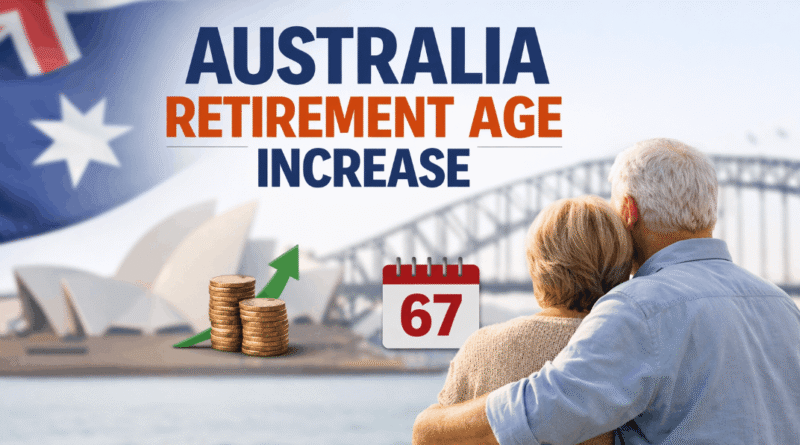
As of March 20, 2026, the Australia retirement age for the Age Pension remains 67 years. There has been no further increase to the eligibility age in 2026.
However, the payment rates have increased due to biannual indexation, with single pensioners receiving an extra $22.20 and couples an extra $33.40 combined per fortnight.
This latest adjustment builds upon the previous Centrelink pension increase 2025, further solidifying the higher income base for Australian households. While the age is stable, the rules around how your savings are assessed have changed.
The 2026 update introduced higher deeming rates (1.25% and 3.25%), which may reduce the total pension for some part-pensioners despite the general rate increase.
The Australia Retirement Age Timeline: From 65 to 67
The current age of 67 is the result of a deliberate, multi-year policy shift designed to modernise the Australian pension system.
Historically, the retirement age was 65 for men (since 1908) and 60 for women. This began to change in the 1990s to equalise the ages and account for Australians living significantly longer lives.
| Birth Period | Eligibility Age | Effective Date of Change |
| Before 1 July 1952 | 65 Years | Pre-2017 |
| 1 July 1952 – 31 Dec 1953 | 65 Years & 6 Months | 1 July 2017 |
| 1 Jan 1954 – 30 June 1955 | 66 Years | 1 July 2019 |
| 1 July 1955 – 31 Dec 1956 | 66 Years & 6 Months | 1 July 2021 |
| On or After 1 Jan 1957 | 67 Years | 1 July 2023 |

Why did the Australia retirement age increase?
The primary driver for the increase to 67 was economic sustainability. With Australia’s Baby Boomer generation entering retirement, the ratio of taxpayers to pensioners has dropped significantly. By raising the age, the government aimed to:
- Reduce the fiscal burden on the federal budget.
- Encourage workforce participation for healthy seniors.
- Account for increased life expectancy, which has risen by nearly 10 years since the pension was first introduced.
Will the retirement age increase to 70 in the future?
There is currently no official plan to increase the Australian retirement age to 70. A previous proposal to reach age 70 by 2035 was officially scrapped in 2018. However, policy experts suggest that if life expectancy continues to climb, a rise to 68 or 69 may be revisited in the 2030s.
New Pension Rates: Effective 20 March 2026
Twice a year, the federal government recalibrates pension payments to ensure they retain their real-world value against inflation.
Following the momentum of the Centrelink boost pensioner payment 2025, this March 2026 indexation is designed to align payments with the latest Consumer Price Index (CPI) data.
These adjustments ensure that the purchasing power of seniors is not eroded by inflation.
Current Fortnightly Rates (Including Supplements):
| Status | Total New Rate (2026) | Fortnightly Increase |
| Single | $1,200.90 | +$22.20 |
| Couple (Each) | $905.20 | +$16.70 |
| Couple (Combined) | $1,810.40 | +$33.40 |
It is critical to remember that while base rates have climbed, your final assessment remains subject to the Means Test. Significant asset growth over the last six months may temper the actual increase you see in your fortnightly payment.
The Silent Change: 2026 Deeming Rate Jump
While the media often focuses on the age, the most important 2026 update for self-funded or part-pensioners is the increase in deeming rates.
For several years, deeming rates were frozen at record lows. As of 20 March 2026, they have been adjusted upward to reflect higher interest rates in the market:
- Lower Rate: 1.25% (on assets up to $64,200 for singles / $106,200 for couples)
- Upper Rate: 3.25% (on assets above those thresholds)
The Invisible Cut: How Deeming Limits Your Gains
If you have $500,000 in financial assets, Centrelink now deems you are earning more income than they did in 2025. This could result in your part-pension being reduced, potentially cancelling out the $22.20 indexation increase.
This pressure stems from the same economic shifts noted during the Centrelink September 2025 cost of living review, where many seniors found that standard indexation struggled to keep pace with rising essential costs.

Checking Your Eligibility: The 2026 Roadmap
To qualify for the Age Pension in 2026, you must meet three core pillars of eligibility.
The Age Requirement
You must be 67 years or older. You can, however, submit your claim to Centrelink up to 13 weeks before your 67th birthday to ensure your payments start the moment you are eligible.
Residency Rules
You must be an Australian resident and in Australia on the day you claim. Generally, you need to have been an Australian resident for at least 10 years in total, with at least five of those years being in one continuous period.
The Means Test (Income & Assets)
Your payment is determined by whichever test (Income or Assets) results in the lower pension amount.
Who is NOT eligible?
If your assets exceed $722,000 (Single Homeowner) or $1,085,000 (Couple Homeowner), you will generally not receive a pension in 2026.
The 2026 Work Bonus
You can earn up to $300 per fortnight from working without it affecting your pension. If you don’t work, this Work Bonus builds up in a bank (up to $11,800), which can be used to offset future earnings.
FAQ about Australia Retirement Age Increase
Is the pension age going up to 70 in Australia?
No. There are no current legislative plans to increase the Age Pension age to 70. It reached 67 in July 2023 and has remained at that level since.
What is the retirement age for a woman born in 1965?
For anyone born on or after 1 January 1957, the retirement age is 67. Therefore, a woman born in 1965 will be eligible for the Age Pension when she turns 67 in 2032.
Can I get the Age Pension at 60?
No. While you can access your Superannuation at age 60 (if retired), you cannot receive the government Age Pension until you reach 67.
How much can I have in the bank and still get the full pension?
In 2026, a single homeowner can have up to $321,500 in total assets (including bank savings and car) and still receive the full pension, provided their income also stays below $218 per fortnight.
Does the 2026 increase happen automatically?
Yes. If you are already receiving the Age Pension, Centrelink will automatically apply the March 2026 indexation. You do not need to contact them.
Can I work while receiving the Age Pension in 2026?
Yes. Thanks to the Work Bonus, you can earn $300 per fortnight from employment without any reduction in your pension.
Final Summary: Navigating Retirement in 2026
The year 2026 is one of stability for the retirement age (67) but volatility for retirement income. With higher indexation rates being balanced against rising deeming rates, your financial strategy must be proactive.
Preparing for the Next Financial Quarter
- Check your Asset Values: Updated property or share valuations could push you over a threshold.
- Review Deeming Impacts: If you are a part-pensioner, use a 2026 pension calculator to see how the 3.25% upper deeming rate affects your specific balance.
- Utilise the Work Bonus: If the cost of living is biting, remember you can return to part-time work with significant income protections.