60k After Tax UK: The 2026 Guide To Take-Home Pay, Tax Traps, Pensions, and Cost of Living
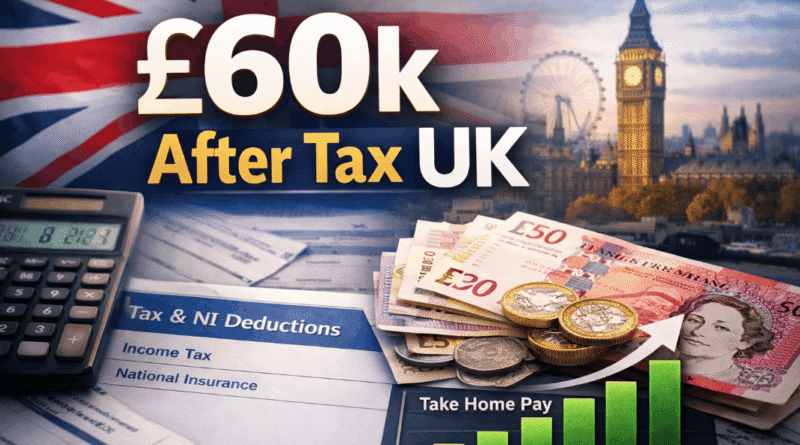
How much is 60k after tax UK? For a salary of £60,000 in the United Kingdom, the final take-home pay depends on income tax bands, National Insurance contributions, and personal allowances set by HM Revenue and Customs.
This article breaks down the exact after-tax income, monthly take-home pay, and the deductions applied to a £60k salary.
For the 2026/27 tax year, a £60,000 salary after tax in the United Kingdom results in approximately a take-home pay of £45,357 per year, £3,780 per month, or £872 per week, assuming a standard 1257L tax code and no additional deductions.
This assumes a standard 1257L tax code with no pension or student loan deductions. With a typical 5% workplace pension contribution, the monthly take-home pay reduces to approximately £3,633.
60k After Tax UK (2026)
For the 2026/27 tax year, a £60,000 salary in the UK produces the following approximate take-home figures under standard tax rules:
| Category | Amount |
|---|---|
| Gross Salary | £60,000 |
| Annual Take-Home | £45,357 |
| Monthly Net Income | £3,780 |
| Weekly Take-Home | £872 |
| Income Tax Paid | £11,432 |
| National Insurance | £3,211 |
If you have a Plan 2 student loan and a 5% pension, this figure drops to approximately £3,275.
How Much Is £60k After Tax in the UK?
A £60,000 salary places you into the Higher Rate tax bracket in the UK, where income above £50,270 is taxed at 40%.
Because only a portion of the salary falls into this higher band, the overall effective tax rate remains around 24%, meaning most workers still retain roughly three-quarters of their gross income after standard deductions.
However, the exact take-home pay can vary depending on:
- Pension contributions
- Student loan repayments
- Tax code adjustments
- Salary sacrifice arrangements
These factors can reduce monthly take-home income by several hundred pounds, depending on the circumstances.
£60k After Tax UK — Quick Facts
- Gross Salary: £60,000
- Net Annual Income: £45,357
- Monthly Take-Home: £3,780
- Weekly Take-Home: £872
- Hourly Gross Pay: £30.77
- Tax Bracket: 40% (Higher Rate)
60k After Tax UK: Detailed 2026 Take-Home Breakdown
As of 2026, the UK tax system remains under a period of fiscal drag, where tax thresholds remain frozen despite rising wages. According to guidance published by HM Revenue and Customs, the Higher Rate tax threshold remains £50,270, meaning more workers gradually fall into the 40% tax band as salaries increase.
This means more of your £60,000 salary falls into the 40% tax bracket than in previous years.
The Mechanics of the 40% Bracket
A £60,000 earner pays a total of £11,432 in Income Tax and £3,211 in National Insurance annually. This leaves a net take-home of £45,357 before voluntary deductions. The Higher Rate threshold remains frozen at £50,270, meaning nearly £10,000 of your salary is subject to the 40% rate.
The Effect on Household Purchasing Power
Understanding the breakdown prevents bill shock when moving from a Basic Rate salary. Because the 40% tax applies only to the portion above the threshold, your effective tax rate is approximately 24%.
However, additional charges like Student Loans or Child Benefit clawbacks can push your marginal tax rate significantly higher.
60k After Tax Summary (England/NI/Wales – 2026/27)
| Category | Annual Amount | Monthly Amount | Weekly Amount |
| Gross Salary | £60,000.00 | £5,000.00 | £1,153.85 |
| Personal Allowance | (£12,570.00) | (£1,047.50) | (£241.73) |
| Taxable Income | £47,430.00 | £3,952.50 | £912.12 |
| Total Income Tax | £11,432.00 | £952.67 | £219.85 |
| National Insurance | £3,210.60 | £267.55 | £61.74 |
| Net Take-Home | £45,357.40 | £3,779.78 | £872.26 |
£60k After Tax UK: Weekly and Daily Take-Home Pay
Breaking down your 60000 salary after tax UK into smaller increments is often more helpful for managing immediate household bills or comparing freelance day rates.
As of the 2026/27 tax year, a standard earner on this salary will see the following net figures:
| Period | Gross Pay | Net Take-Home |
| Weekly | £1,153.85 | £872.26 |
| Daily (5-day week) | £230.77 | £174.45 |
| Hourly (37.5hr week) | £30.77 | £23.26 |
These figures provide a baseline for a £60,000 salary after tax in the UK before any pension contributions or student loan repayments are deducted.
How Much Tax Do You Pay on £60k in the UK?
On a £60,000 salary in the 2026/27 tax year, total mandatory deductions include:
- Income Tax: £11,432
- National Insurance: £3,210
This results in total tax deductions of approximately £14,643 per year, leaving a take-home pay of roughly £45,357 annually.
Although the marginal tax rate on part of the income is 40%, the overall effective tax rate is about 24% because the first £12,570 of income remains tax-free under the Personal Allowance.

The 60k Trap: Child Benefit and Marginal Tax Rates
Crossing the £60,000 threshold triggers the High Income Child Benefit Charge (HICBC). In 2026, for every £200 of adjusted net income earned over £60k, you must repay 1% of your Child Benefit. At £80,000, the benefit is lost entirely.
This creates a tax trap where your effective tax rate on every pound earned over £60k is significantly higher than 40%.
How This Affects Your Disposable Income
If you receive a pay rise from £59,000 to £61,000, the extra £2,000 gross results in much less actual disposable income than expected.
For parents, this makes Salary Sacrifice into a pension an extremely attractive option to keep your Adjusted Net Income below the £60,000 threshold, effectively protecting your child benefit.
Case Study: Tax Efficiency in Action
A parent of two children earns £65,000. Their HICBC is 25% of the total benefit received. If they contribute £5,000 to their pension via salary sacrifice, their income for HICBC purposes drops to £60,000. They not only save the 40% tax on that £5,000 but also eliminate the 25% benefit clawback.
Real Take-Home Pay on £60k (Common Scenarios)
Your actual take-home pay from a £60,000 salary can vary depending on pension contributions and student loan repayments. The following examples show typical monthly outcomes.
| Scenario | Monthly Take-Home |
|---|---|
| No deductions | £3,780 |
| 5% workplace pension | £3,633 |
| Student Loan Plan 2 | £3,544 |
| 5% pension + Plan 2 loan | £3,275 |
These figures illustrate how common deductions can reduce disposable income by several hundred pounds each month.
How Student Loans Affect £60k Take-Home Pay
If you are calculating 60k after tax UK with student loan deductions, your monthly cash in hand will be lower. Repayments are calculated on your gross income above specific thresholds:
- Plan 1: 9% over £26,065. Monthly deduction: ~£254.
- Plan 2: 9% over £28,470. Monthly deduction: ~£236.
- Plan 4 (Scotland): 9% over £31,395. This plan applies to students who applied to the Student Awards Agency Scotland (SAAS). Because the threshold is higher than Plan 1 or 2, your monthly deduction is lower at ~£214.
- Plan 5: 9% over £25,000. Monthly deduction: ~£262.
- Postgraduate Loan: 6% over £21,000. Monthly deduction: ~£195.
Monthly Take-Home with Student Loans (No Pension)
| Loan Plan | Monthly Deduction | Final Monthly Net |
| No Loan | £0 | £3,780 |
| Plan 4 (Scotland) | £214 | £3,566 |
| Plan 2 | £236 | £3,544 |
| Plan 1 | £254 | £3,526 |
| Plan 5 | £262 | £3,518 |
How £60k Compares to Other UK Salaries After Tax
Understanding where £60,000 sits within the wider UK salary range helps benchmark its real purchasing power.
Each salary level above can vary depending on pension contributions, student loans, and tax code adjustments, which is why detailed breakdowns are useful when comparing different income levels.
These figures assume standard tax codes and no additional deductions. As income increases beyond £50,270, a larger portion falls into the Higher Rate tax band.

Regional Living: 60k in London vs. The North vs. Scotland
A £60,000 salary provides vastly different lifestyle outcomes depending on UK geography. In 2026, rent and mortgage interest rates will remain the primary differentiators.
Local Differences and Tax Variations
An employee on £60,000 in Glasgow will pay significantly more in Income Tax than an employee in Manchester.
According to the Scottish Government’s 2026 technical factsheet, the Scottish Higher Rate is 42% and begins at just £43,663, meaning a £60k earner in Scotland pays roughly £1,750 more in tax annually than they would in England.
Housing and Borrowing Power
Mortgage affordability on a £60,000 income is more nuanced than a simple salary multiple. While lenders typically offer 4.5x your gross salary, resulting in a loan of £270,000, the 2026 lending environment focuses heavily on discretionary income.
Lenders conduct stress tests to ensure you can still afford repayments if interest rates rise. On a £60k salary, a high student loan payment or a car lease can effectively reduce your borrowing power by £30,000 or more because they reduce the monthly cash available for mortgage service.
Additionally, your deposit size dictates your Loan-to-Value (LTV) ratio; reaching a 15% or 20% deposit often unlocks significantly lower interest rates, which increases your overall affordability.
However, long-term affordability is heavily dictated by the central bank’s monetary policy, making it vital to monitor the UK interest rate forecast for next 5 years before committing to a fixed-rate product. In the North, you can save £1,000+ monthly; in London, £400 is more realistic.
Example Scenario: £60k Salary With Pension and Student Loan
To understand a realistic 60000 salary after tax UK outcome for a graduate professional, consider an employee with a 5% pension contribution (via salary sacrifice) and a Plan 2 student loan:
- Gross Monthly Income: £5,000
- Income Tax (Standard): -£953
- National Insurance: -£268
- Pension Contribution (5%): -£250
- Student Loan (Plan 2): -£245
- Final Monthly Take-Home: £3,284
In this scenario, your cash-in-hand is roughly 65% of your gross earnings.
How Your Tax Code Changes Your £60k Take-Home Pay
Your tax code tells your employer how much tax-free income you are entitled to. A wrong code can lead to significant underpayment or overpayment of your 60000 salary UK take home pay.
- 1257L: The standard code for 2026, giving you £12,570 tax-free.
- Emergency Codes: Often applied when starting a new job without a P45; these may result in higher initial tax.
- K Codes: These occur when your taxable benefits (like a company car) exceed your personal allowance, meaning you pay tax on more than your total salary.
Compliance and HMRC Penalties to Avoid
Failing to declare your income over £60,000 if you receive Child Benefit can lead to significant HMRC penalties.
Practical Update for 2026: HMRC has now fully rolled out the digital HICBC service, allowing you to pay the charge directly through your tax code in real-time, potentially removing the need for a full Self-Assessment return.

Step-by-Step: Reclaiming Higher Rate Tax Relief
If you pay into a private pension (SIPP) or a workplace Relief at Source scheme, you only receive 20% tax relief automatically. You must claim the other 20% manually.
- Gather Evidence: Collect your annual pension statement showing your Net contributions.
- Calculate Gross-Up: Multiply your net contribution by 1.25 to find the Gross amount HMRC recognizes.
- Register for Self-Assessment: If not already registered, sign up via GOV.UK by October 5th.
- Fill the Return: Enter the Grossed-up pension total in the section for Payments to registered pension schemes.
- Claim via Tax Code: Alternatively, call HMRC to have your tax code adjusted for the current year.
- Verify Refund: HMRC will typically issue a rebate check or reduce your monthly tax for the next year.
Why a £60,000 Salary Faces a 62% Marginal Tax Rate
Most online calculators provide your Effective Tax Rate (the total tax divided by your total income), which sits at a respectable 24% for a £60,000 earner. However, this figure hides the Marginal Tax Rate, the actual amount of tax you pay on every additional pound you earn.
Understanding the 2026 Tax Cliff
When your income moves from £60,000 toward £80,000, you aren’t just paying 40% Income Tax. You are also subject to the High Income Child Benefit Charge (HICBC).
In the 2026/27 tax year, this clawback scales at a rate that effectively adds roughly 10% to 20% to your tax bill for every pound earned in this bracket, depending on how many children you have.
The Reality for Families:
- Income Tax: 40%
- National Insurance: 2% (above the Upper Earnings Limit)
- Child Benefit Clawback: ~10% to 20%
- Total Marginal Rate: Up to 62%
Practical Impact: If you have three children and receive a £1,000 bonus that takes your pay from £60,000 to £61,000, you may only see £380 of that money in your bank account. The other £620 is consumed by tax, NI, and lost benefits.
Expert Interpretation: This is why financial advisors refer to the £60,000 to £80,000 range as an efficiency dead zone.
For many, the most rational move is not to take the extra cash, but to use Salary Sacrifice to keep their Adjusted Net Income at exactly £60,000. By doing so, you avoid the 62% hit and instead divert that expensive money into your pension, where it grows tax-free.
Key Takeaways: £60k Salary After Tax UK
A £60,000 salary places you comfortably within the UK Higher Rate tax bracket and produces a high take-home income compared to the national average.
Key points to remember:
- A £60k salary results in around £3,780 monthly take-home pay under standard tax rules.
- The Higher Rate tax band begins at £50,270, meaning nearly £10,000 of income is taxed at 40%.
- Student loan repayments can reduce take-home pay by £200–£260 per month.
- Pension contributions lower taxable income and improve long-term financial security.
- Child Benefit begins to be clawed back once adjusted net income exceeds £60,000.
Understanding these factors allows workers to structure pensions and salary sacrifice arrangements more efficiently.
Frequently Asked Questions
How much is £60,000 a month after tax?
It is approximately £3,780, excluding pension contributions or student loan repayments, based on 2026/27 tax rates.
Do I lose my child benefit if I earn 60k?
Clawback begins at £60,000; the benefit is fully lost only when your adjusted net income reaches £80,000.
Is £60,000 a good salary in the UK?
In the United Kingdom, a £60,000 salary is roughly 50% above the national median income, placing earners within the top portion of the workforce, depending on region and profession.
How much mortgage can I get on 60k?
Most lenders offer 4.5x salary, allowing a maximum mortgage of approximately £270,000.
What is 60k after tax in Scotland?
You take home roughly £3,631 monthly, which is £149 less than in England due to higher rates.
Is £60k a middle-class salary in the UK?
Yes, £60,000 is widely considered a solid middle-class income, placing you in the top 15% of earners nationally.
What salary puts you in the top 10% in the UK?
As of 2026, you typically need an annual income of approximately £72,000 to enter the top 10% of UK taxpayers.
How much pension should I contribute on £60k?
Contributing enough to bring your Adjusted Net Income down to £50,270 is highly tax-efficient, as it saves 40% tax.